Let me get this straight. Roughly half of the people in this country are saying they’ll vote for a guy who has been the common denominator in having problems with and/or criticizing (a partial list, excluding Democratic officials):
1. A former Presidential candidate who was a Prisoner of War
2. The Pope
3. Women 4. The people of an entire religion (Muslim) 5. Presidents George H.W Bush, George W Bush and their brother Jeb 6. Former Presidential candidate Mitt Romney 7. The people of Mexico 8. Presidential candidates Kasich, Cruz, Fiorino, and Rubio 9. So-called Presidential candidates Christie and Carson 10. A Fox News anchor and debate host 11. The media, in general, including barring media he doesn’t like. 12. Disabled people, via a NYT reporter suffering from arthrogryposis 13. A retired four-star U.S. General 14. A Judge presiding over his alleged case of fraud involving Trump University (because the American-born Judge was of Mexican descent) 15. A Colorado Springs Fire Marshall (who was enforcing laws) 16. Former Speaker of the House 17. Current Speaker of the House 18.The AFL-CIO 19. Hispanics 20. Native Americans 21. Neil Young 22. And now, today, the mother and father of Humayun Khan, an United States Army captain who gave his life in Iraq.
The right to cast a vote is the most important right of a citizen of the United States, wouldn’t you say?
We're starting up "Brackets on the Side" at Johnnie's in Boston. The crowd will be packing in by the big screen HDTVs upstairs and downstairs at our joint.
We're encouraging everyone to bring their brackets and finish them up by Noon (or scratch them off or tear them up and start over again later this evening!).
Be there.
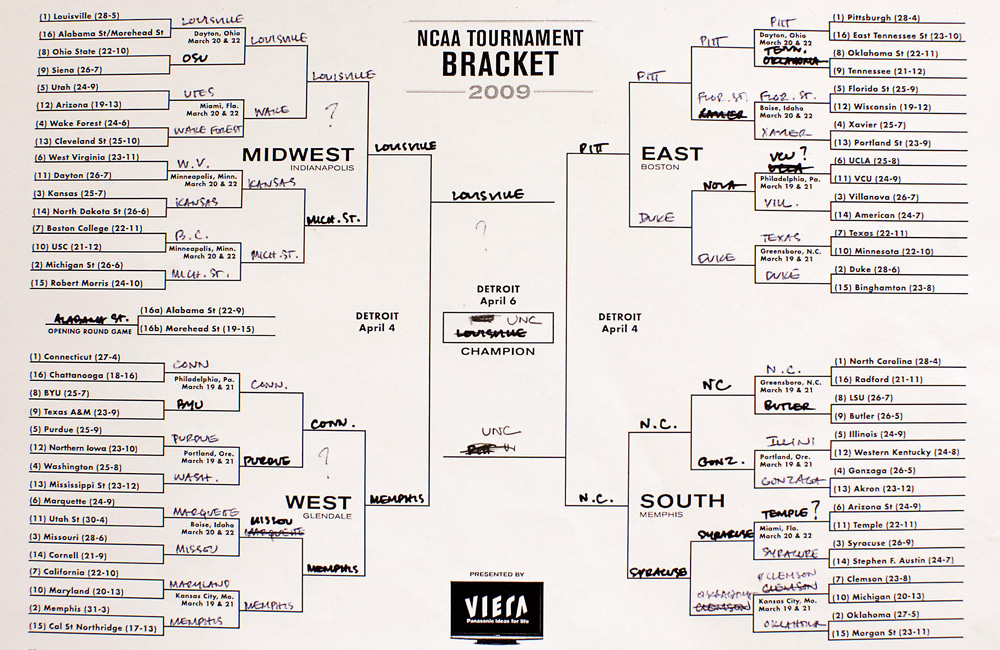
And, BTW, click on the March Madness headline above to consult the bracket filled out by the leader of the free world, the great President Barack Obama. (Not sure about the Duke picks...)
He earned new respect from all sports fans with his tremendous appearance with ESPN's Andy Katz. Some people might criticize the President for taking the time away from his primary duties of running the country and trying to solve the economic crisis to do brackets. But, these are my thoughts:
1. Whoever says that should look in the damn mirror. (Do you spend every minute of your life on your work? Do you deserve a few minutes of fun with your friends to celebrate the true American (and global) pastime of the sport of BASKETBALL? A few minutes time to enjoy a whole month of NCAAs?
2. He kept his promise to ESPN's Andy Katz. That is HUGE.
3. The man picked a pretty good bracket and knows his stuff. There is no doubt he is one of the smartest people who have ever walked the planet, plus he knows his hoops. Case closed.
4. He had the "political" guts to pick against 32 colleges! That's a lot of votes!
5. Hands down, he has earned my VOTE and my respect for the rest of his life and the rest of mine, not because of his love for basketball but because of his down-to-earth honesty and ability to relate to people and give honest answers to honest questions. May God Bless Barack Obama and his wonderful family.
I grew up with idols named John Kennedy, Bobby Kennedy and Dr King.
I have a new "American Idol" and his name is President Obama.
Again, I just can't resist one, last, fun, quick, easy and VERY ENTERTAINING post, courtesy of CNN. Out of some R-E-S-P-E-C-T for the office of the POTUS, I will lay-off - no pun intended - poking fun at "W" for a while. (Unless, of course, he does something really weird.)- (Note the video spelling of the word 'idiot.')
Baseball season is nearly upon us. The World Baseball Classic is gaining some momentum. Here is an interesting Q&A with Dr. Harvey Schiller that was posted last week on a great new site called NY Sports Journalism.com.
By Barry Janoff
This will be a busy, and pivotal, year for baseball. Beginning in March with the World Baseball Classic, continuing through the MLB season and World Series in October and including the Baseball World Cup in September (which will be played throughout Europe with 22 teams, including the U.S.), supporters of the game will be working on efforts to have baseball reinstated as an Olympic sport. The International Olympic Committee in 2005 voted to drop baseball and softball following the 2008 Summer Games, and thus will not be part of the 2012 Games in London. The IOC is scheduled to vote on two of seven sports seeking Olympics Games reinstatement on Oct. 3, the day after it is scheduled to select the 2016 Summer Games venue (from among Chicago, Tokyo, Rio de Janeiro and Madrid). The others seeking reinstatement are golf, karate, roller sports, rugby and squash. Dr. Harvey Schiller has been president of the International Baseball Federation, the sport's worldwide governing body, since 2007. In this position, he is at the forefront of dealing with the political, financial, logistical and personal issues involved in getting baseball (and softball) reinstated. But the former executive director of the USOC is up for the challenge, having previously worked for two of the toughest bosses in sports (or elsewhere): Ted Turner when Schiller was president of TBS Sports, and George Steinbrenner when Schiller was CEO of YankeeNets. Dr. Schiller spoke about the challenges ahead with NYSportsJournalism.com.
NYSportsJournalism.com: Does it seem logical that there won't be baseball in the 2012 Olympics in London? Or is that confusing logic with politics? Dr. Harvey Schiller: After Jacques Rogge was elected president of the IOC in 2001, one of his mandates was to try to reduce the number of sports in the Olympics. He asked for a review of all the sports that were on the program. My understanding is that there were a large number of older sports that, along with baseball and softball, were marked for possible elimination. People have told me that baseball and softball became victims of new sports versus the older sports, because [at the time] they were the two most recent sports added to the program [baseball became an Olympic sport in 1992 and softball in 1996]. So we got caught up in a lot of politics.
NYSJ: What is the IOC's concern regarding after-use of stadiums? Dr. Schiller: They felt we weren't able to convert stadiums built for the Olympics into venues for baseball. But that is exactly what we did with the Olympic Stadium in Atlanta [built for the 1996 Summer Games], which was converted into a baseball stadium that is now Turner Field [and has been home to the Braves since 1997]. Looking ahead to 2016 and the four cities that are finalists to host the Summer Games and how they relate to baseball: Tokyo has a stadium [55,000-seat Tokyo Dome, where the Yomiuri Giants play] so you don't have to build anything, and the national pastime in Japan is baseball. In Chicago, you have two stadiums in the city [Wrigley Field and U.S. Cellular Field] that would bring in $30 million in revenue for the Olympics just from baseball. Baseball is pretty big in many cities in Brazil and Rio de Janeiro has some exclusive baseball stadiums. And for Madrid, games could be played in Barcelona, where baseball first became an Olympic sport, which would not be unusual.
NYSJ: It would seem that guaranteeing star players is a more difficult issue, especially for an event seven years away. Dr. Schiller: In the 2008 Summer Games in Beijing, of the eight teams that participated, five had absolutely their best players and the only team that did not have players off of the 25-man roster was the United States, which sent players off of the 40-man roster. So what we are doing, and what baseball commissioner Bud Selig has said, is that the roster will be the best players ever to participate from Major League Baseball. What does that mean? I can't answer that today because it's up to the players themselves to participate.
NYSJ: So you think the IOC wants the U.S. to guarantee an All-Star Game-type roster, which might be difficult in the middle of the MLB season? Dr. Schiller: What I really think President Rogge wants is not that we have 25 players off the 25-man rosters but that, as in tennis in Beijing, when Roger Federer and Rafael Nadal were there, he wants a couple of major stars. At the meeting we had with the IOC in Lausanne, Switzerland. in November, one of the questions was, "Will you bring your stars?" My reply was, "We have 30 [MLB] teams. The starting rotation has five pitchers, so that's 150 pitchers. So you tell me which are the stars. I can't define that [seven years] from now." A good example is Curtis Granderson [of the Detroit Tigers], whom we took with us to the IOC presentation. In today's world he is certainly a valuable player, but he doesn't get the attention that Derek Jeter gets. In my view, Curtis is a star and would be a great representative of this country.
NYSJ: Was it a surprise when baseball was voted out? Dr. Schiller: It was a surprise, and part of the surprise was that because baseball and softball are U.S.-based sports that there might at the time have been an anti-American feeling. If you look at the seven sports that are being considered for reinstatement, baseball and softball [were voted out] by one or two votes while the others lost by 60, 70 votes. But I don't want to make light of that because this is a new world and you never know how IOC members will vote.
"The reaction was good. They know it's within their best interests to get back into the Olympic program. The big [issue] is getting the best players in there." - Schiller
NYSJ: Is this a pivotal year for baseball to prove itself, if that is the term, to the IOC, with the World Baseball Classic, the Baseball World Cup and MLB itself all offering the IOC a first-hand look at the globalization of the sport? Dr. Schiller: Certainly. The WBC is a major media event and will be shown in more than 200 countries. The most important part is that the 16 participating teams have the opportunity to train and compete at the highest level. So teams from South Africa, Italy and the Netherlands go to spring training and get to play against MLB players. It is unique in sports. That would be like a team in the World Cup coming into London to train against Manchester United.
NYSJ: What type of support are you getting from marketers and potential sponsors? Dr. Schiller: We are very fortunate in that we have the full support of Major League Baseball, which in turn is able to deliver support to us through marketers who work with MLB.
NYSJ: Regarding steroids, do you see a double standard, where baseball players such as Barry Bonds, Roger Clemens and Mark McGwire who are linked to banned supplements are ostracized but stars in other sports with similar situations are not? Dr. Schiller: It's complex. Baseball is so proud of its records. The nature of baseball is nine against one and one against nine. And when you measure it that way it is unique among team sports. The love of the game around the world focuses on individuals. People relate to individual players and have grown up with them. Whether it was Jackie Robinson or Mickey Mantle, that was your guy. When you grow up you realize players have their flaws. But when you are 10 or 11, you don't want to hear [anything negative]. In some other team sports, people don't seem to care as much about that in the long run. Baseball is the only sport on a national basis that you are going to read about every day. In the middle of summer, you won't see a lot of NFL stories. But in the middle of the NFL season, there were headlines about baseball players being signed, being traded, every day.
NYSJ: You recently attended the MLB owners meeting and presented them with an update on the Olympic situation. What was their reaction? Dr. Schiller: The reaction was good. They know it's within their best interests to get back into the Olympic program. The big [issue] is getting the best players in there.
NYSJ: President Obama has already given his support behind Chicago hosting the 2016 Olympics. Will he support the return of baseball to the Olympics as well? Dr. Schiller: Yes. We have been working with his people. At the IOC meeting in November we used as part of our presentation a photo of him throwing out the first pitch at a Chicago White Sox game wearing a White Sox cap.
NYSJ: With ten being the highest, how would you rate baseball's chances of being reinstated for 2016? Dr. Schiller: A ten, of course.
***
Confessions of a Blogger. See this interesting article from Boston.com, posted last week:
My Blog Ate My Career
I'm perfectly qualified for a job -- just don't look me up online.
By LINDA KEENAN
If this were Facebook, my status update might read this way: "Linda is . . . terrified that her reckless blogging and social networking has rendered her utterly, irrevocably unemployable." In another life, I was a CNN head writer and senior producer. These days, Google my name, and in a few clickety clicks, you'll find a sorry list of intimate grotesqueries I've catalogued about myself for all the world to read.
I would like to work again full time. And if I were applying to be, say, Flava Flav's girlfriend or an unhinged Real Housewife on Bravo, I might well prove qualified. But would I blame a proper boss in this brutal job market for ignoring me because of my online shenanigans? No. The fact is: I wouldn't hire me either. Further, I'm not sure I'd let me in the PTA, or even near my kid. An employer typically looks for someone trustworthy, helpful, courteous. My attributes, etched forever in the digital record, read like a perversion of the Boy Scout Law.
Disloyal I compared some unnamed news anchors I had worked for to my toddler -- discussing their flatulence, their bald spots, their screaming red-faced tantrums -- and declared my toddler more mature.
Sexist I wrote that Sarah Palin's recipe for Middle East peace was Tater Tot Casserole.
Petty I resolved this New Year to fire 10 Facebook friends for non-responsiveness.
Sanctimonious I decided to get my next Pap smear done by a Sikh doctor, in a purely political act, after hearing that other patients were unjustly scared of him and his turban.
Histrionic I accused my husband of having spiritual intercourse with his beloved snow blower.
Disrespectful I surmised that the only thing Hillary Clinton and Rocky Balboa might have in common is that they can both break thumbs.
Unneighborly I said a nearby home with wildly overgrown grass needed what I called a "Lawnzilian," the landscape version of the scorched-earth Brazilian bikini wax.
Insensitive After watching an aging, ailing cigarette addict on YouTube, I declared that while I had done some things I wasn't proud of, smoking through a trach hole wasn't one of them.
Unstable I declared myself an "out and proud suburban pill popper" and joked about helping myself to an "extra slice of Klonopin" for dessert one very bad night.
Lazy/Pathetic I admitted to lolling around, moonily watching YouTube clips of Ice Castles, Yentl, and the Colin Firth Pride and Prejudice. Pugilistic/Hyperbolic I accused Al Gore of killing Christmas, for helping to turn my son into a tiny eco-terror. My boy kept shutting off our tree, wagging a little finger at me about wasting power.
Polyamorous I said I would gladly apply to be Bill Paxton's fourth wife on the polygamist soap opera Big Love. I declared my irrepressible longing for comedian Russell Brand, actors Jon Hamm and Hugh Laurie, and legal whiz Jeffrey Toobin. (I know, go figure. The heart wants what it wants.) I said I wanted to have a million of 1982 Bono's babies. (2009 Bono, not so much.) I also said that various women I admired were turning me gay, which proved me to be both polyamorous and cliche.
Just Plain Mean I wrote a satire piece about Federal Reserve chairman Ben Bernanke failing to stimulate the economy and resorting to Cialis.
Now, if I were in my 20s, this might all be filed under the things the "yoots" do these days in the digital era. But I'm old enough to remember analog, Atari, Bill Clinton. A boss has every right to judge me by what I've put out there. So does my son. I can see him, a decade from now, reading this stuff, with that defeated look that you see sometimes on Jerry Springer when kids try to get their dissolute mothers to stop acting like overstuffed teenage tarts. And I can hear him say, "For God's sake, Mom, stop talking about your cervix, step away from that computer, take those horrifying pictures down, grow the hell up, and get a job."
If only I could.
***
These Days?
We're all wondering what will happen in the world.
The new President. The financial crisis. The war(s).
High costs.
Energy concerns.
Lost jobs.
Retail stores closing each and every day.
Duane Allman had it down:
These Days
Well I've been out walking I don't do that much talking these days These days These days I seem to think a lot About the things that I forgot to do For you And all the times I had the chance to
Well I had a lover I don't think I'll risk another these days These days These days I seem to be afraid To live the life that I have made in song But it's just that I have been losing For so long
***
These days I sit on cornerstones Count the time in quartertones 'till ten My friend And now I believe I've come To see myself again
***
These days I sit on cornerstones Count the time in quartertones 'till ten My friend Please don't confront me with my failure I'm aware of it
***
U2 will release their new album today. Here is some news from their site:
Get On Your Boots, the first single from U2's new album No Line On The Horizon, will be released as a digital download on February 15th with a physical format to follow on February 16 through Mercury/Universal (UK).
Produced by Brian Eno, Danny Lanois and Steve Lillywhite, sessions for No Line On The Horizon began in Fez, Morocco, and continued at the band's Dublin studio, New York's Platinum Sound Recording Studios, and London's Olympic Studios.
Released on March 2nd (March 3rd in the US), the album will come in a standard format with 24 page booklet and in digipak format. The digipak includes an extended booklet and the album's companion film "Linear" by Anton Corbijn. A limited edition 64 page magazine will also be available, featuring the band in conversation with artist Catherine Owens, and new Anton Corbijn photographs. No Line On The Horizon will be released on 180gm vinyl. (More on the formats below)
The album cover artwork is an image of the sea meeting the sky by Japanese artist and photographer Hiroshi Sugimoto.
Here's the full tracklisting:
1. No Line On The Horizon 2. Magnificent 3. Moment of Surrender 4. Unknown Caller 5. I'll Go Crazy If I Don't Go Crazy Tonight 6. Get On Your Boots 7. Stand Up Comedy 8. Fez - Being Born 9. White As Snow 10. Breathe 11. Cedars Of Lebanon
A quick post from the porch of a local public library's wireless account to do something I very rarely do and that is to credit the POTUS with the fact he is attending the Beijing Olympics.
I am a firm believer that we must work hard to separate the Olympics from politics. I know that is a dream and not very realistic, but I think the Olympic Games are about the athletes, not a forum to sway public opinion. I dream that the TV cameras would concentrate on a long-shot Olympian finishing 14th rather than 34th and having the performance or his/or/her life, rather than Lebron's take on Darfur.
I guess I'll need to read the lyrics to John Lennon's "Imagine" a few times.
Anyhow, I saw this AP story on President Bush's trip to China and pass it along to float the issue. Read on:
By Paul Alexander Associated Press Writer / August 7, 2008
BEIJING—President Bush is eagerly awaiting the start of the Summer Olympics, making history as the first president to attend this world athletic competition on foreign soil.
But his arrival in Beijing Thursday night on the eve of the opening of the games came amid an atmosphere of tension with China's leaders over his high-profile speech in Thailand exhorting the growing world power to grant more freedom to its people.
Bush, first lady Laura Bush and their daughter Barbara came off Air Force One together, where they got a red-carpet greeting from Chinese Foreign Minister Yang Jiechi and others, and then sped away in a motorcade.
Bush, an avid sports fan, has said he wants to enjoy the Summer Olympics competition, but also will talk to President Hu Jintao about human rights and a host of other bilateral issues.
Before his plane landed here, China's Foreign Ministry released a terse statement saying that no one should interfere with China's internal affairs.
Bush plans to attend the opening ceremony of the Olympics on Friday night and go to a series of sporting events through Monday, including U.S. basketball and baseball games against China. Although he exhorted Beijing to improve human rights in a major speech in Thailand before flying here, Bush has said he is intent on making his Olympics visit about sports, not politics.
In a speech outlining America's achievements and challenges in Asia, Bush had pushed Thursday for a free press, free assembly and labor rights in China, and spoke out sharply against its detentions of political dissidents, human rights advocates and religious activists. He said he wasn't trying to antagonize China, but called such reform the only path the potent U.S. rival can take to reach its full potential.
He antagonized the Chinese anyway, setting the stage for an interesting reception when he attends the opening ceremonies Friday evening and meets with Hu on Sunday after attending church.
"The Chinese government puts people first, and is dedicated to maintaining and promoting its citizens basic rights and freedom," Foreign Ministry spokesman Qin Gang said Thursday in response to Bush's speech. "Chinese citizens have freedom of religion. These are indisputable facts."
He said China advocates discussions on differing views on human rights and religions on "a basis of mutual respect and equality," then indicated it didn't see Bush's criticism in that light.
"We firmly oppose any words or acts that interfere in other countries' internal affairs, using human rights and religion and other issues," Qin said.
Bush did offer praise for China's market reforms. "Change in China will arrive on its own terms and in keeping with its own history and its own traditions," he said. "Yet, change will arrive."
Bush has been trying to walk a tightrope in attending the games, wanting to avoid causing Beijing embarrassment during its two weeks on the world stage while also coming under pressure to use his visit to openly press China's leaders for greater religious tolerance and other freedoms. Chinese officials bristled when he met with Chinese activists at the White House last week.
"With this speech, Bush is trying to address two polar issues: easing the controversy created by those who oppose his visit during the Games and simultaneously maintaining America's strategy with China," said Yan Xuetong, an expert in U.S.-China relations at Beijing's prestigious Tsinghua University.
Making the repression issue timely, China has rounded up opponents ahead of the Olympics and slapped restrictions on journalists, betraying promises made when it landed the hosting rights.
Australian Prime Minister Kevin Rudd urged the international community "to speak with a strong and united voice" to maintain pressure on China over human rights. But he conceded Beijing's record has improved.
"Remember, it was not all that long ago they were in the middle of the cultural revolution with people getting put up against a wall and basically knocked off," he told Nine Network television before flying to Beijing.
The White House's handling of the speech demonstrated the president's delicate balancing act. Bush's address containing the criticism of China was delivered outside the country, in Thailand. The White House took the unusual step of releasing the text of it even earlier, about 18 hours before he spoke.
And the speech was followed by a string of events Thursday, by both the president and his wife, that were clearly aimed at shifting the focus to the repressive military regime in Myanmar, neighbor to Thailand, where Prime Minister Samak Sundaravej regards himself as a friend of Myanmar's generals. Myanmar, also known as Burma, marks the 20th anniversary of a brutal crackdown on pro-democracy activists on Friday.
In his speech Thursday, Bush also urged North Korea to live up to its promise to dismantle its nuclear weapons, adding: "The United States will continue to insist that the regime in Pyongyang end its harsh rule and respect the dignity and human rights of the North Korean people."
I call your attention to this, the official White House transcript of Ms. Dana Perino's daily briefing:
###
Q When will President Bush get a look at the Mitchell Report on use of steroids in baseball? And what kind of burdens and responsibility does the President think is on the owners of baseball to do something about the problem?
MS. PERINO: Well, the President looks forward to seeing the report by Senator Mitchell. He has not seen it yet, and the President hopes that this report marks the beginning of the end of steroid abuse. I would remind you that in 2004, the President used time in his State of the Union address to highlight the problem that he saw with steroid abuse, especially because of the message that it sends to children who look up to professional athletes. The President called on team owners and union representatives, coaches and players, to take the rid -- take the initiative to get rid of steroids in baseball. We'll look at the recommendations; there might be recommendations within the report that we haven't seen yet that speak specifically to owners, and so we'll take a look at that.
Q The President has noted that the Players' Association was not particularly cooperative. Does he call on everyone now within that community to be a little more cooperative on the issue?
MS. PERINO: Well, I -- the President would seek cooperation from everyone because it's in the best interests of baseball, the best interests of our children, and ultimately for all professional sports for there to be clear transparency on this matter.
Q Is there a federal government role in this?
MS. PERINO: Not that I'm aware of.
Q Follow on that?
MS. PERINO: Let me tell you, the one part of the federal government role is something that the President did, which is that he decided in 2004 to shine a light on this issue because he saw it as something that was important enough to raise in the State in the Union, and all of you know, cover the White House, that issues that are brought up in the State of the Union carry great weight with the President.
Q May I follow?
MS. PERINO: Wendell.
Q Jose Canseco, who played for the President's team from '92 to '94, has said he cannot comprehend why Mr. Bush didn't know that steroid use was going on, on the team. Does the President regret that? Has the President thought about how it was he missed that?
MS. PERINO: Well, the President said -- I would point you to the ESPN interview from earlier this year in which he said that he did not recall steroids being used or discussed in that period in 1993 or before. But now that we have this report, which is something the President encouraged, we can shine a light on this problem and hopefully bring help to those who need it, and make sure that kids know that the strength of their character is what counts, not performance on the playground.
Q Does he regret, though, the fact that he didn't know? Does he understand why he didn't know? Did he feel he wasn't paying enough attention, or was it hidden from him?
MS. PERINO: The President said he thought long and hard about it, he just does not recall ever hearing it or seeing it. And I don't think it's time for regret; I think it's time to do what the President has done, which is take time in a State of the Union address to shine light on the issue. And now we have a result of a report that is getting a lot of attention and deservedly so.
Roger.
Q Can I just follow on that? Will we hear from the President, specifically, after the report is out?
MS. PERINO: Today? I doubt it.
Q Today or the next day or two?
MS. PERINO: I won't rule anything out, but I don't think you'll hear from him today. But I'm here on his behalf.
Q And do you know, generally, does he feel that Major League Baseball has essentially looked the other way on this problem?
MS. PERINO: Well, I think that this report is an acknowledgment that they have a problem and that they're trying to resolve it.
Q Does the President feel that since baseball has looked into this it needs to expand to other sports?
MS. PERINO: That is one thing I haven't talked to the President about. But I think that steroid abuse in any professional sport would be something that the President doesn't think is necessary, thinks everyone should be able to compete on their own mettle -- and especially for children, who look up to professional athletes across the board. Steroid abuse is just -- it's not a good idea for anybody, for their own health and for the message it sends to children.